Mangroves Boardwalk Trail, Carnarvon Heritage Precinct Mangroves Boardwalk Trail, Carnarvon Heritage Precinct


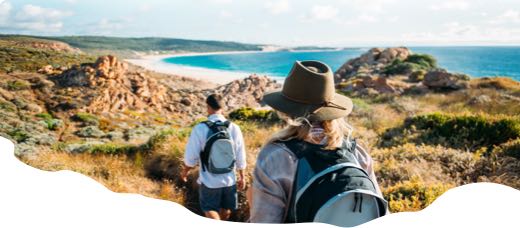
Trails WA supports the seven principles recommended by Leave No Trace Australia for minimising your impacts when using the trails.
Learn moreAbout Mangroves Boardwalk Trail, Carnarvon Heritage Precinct
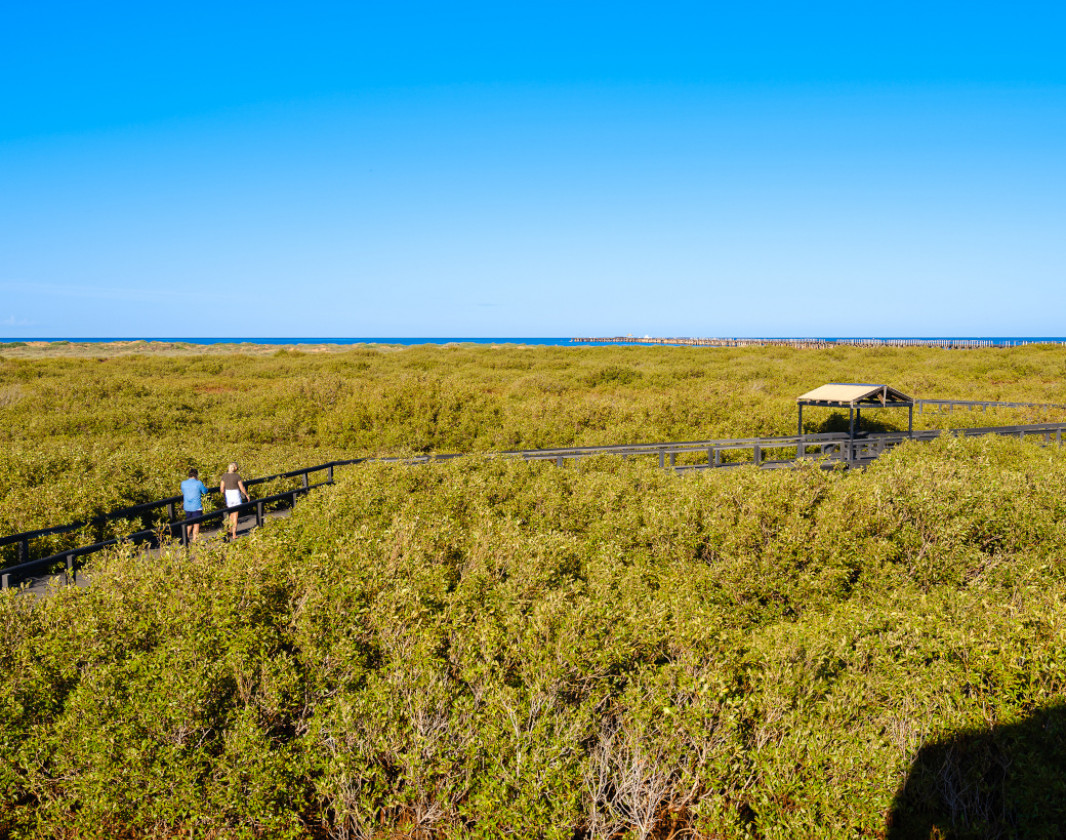
Carnarvon’s shallow shores support a healthy mangrove community. The Gascoyne River has deposited large amounts of silt at its mouth. Over the last 20 to 30 years this has changed the shape and vegetation of the delta. The wetlands and mangroves you see are new habitats formed by siltation of the river mouth.
Only one mangrove species – Avicennia marina, the white (or grey) mangrove is found in Carnarvon and areas south. The mangroves, known as mangals, are rich in terrestrial life including insects, birds, and bats, as well as supporting marine life such as crabs, prawns, fish, and marine snails.
The coastline from Carnarvon south to Gladstone Bay is lined with dense mangrove forest. Mangroves play an important role in the functioning of our marine ecosystem. Fish, prawns, and crabs, come to mangroves to spawn, then leave their young to grow in relative safety among the mangrove roots.
The structure is made of a 100% recycled wood plastic composite and has been constructed by Durack Institute of Technology, Carnarvon Campus students.
Carnarvon Visitor Centre
(08) 9941 1146
- [email protected]
- Visit website
- 21 Robinson Street, Carnarvon WA 6701
Other Links
-
Australia’s Coral Coast
Comprehensive information on the Coral Coast region including destinations, things to see and do, accommodation and tours.
Be trail ready for Mangroves Boardwalk Trail, Carnarvon Heritage Precinct
Here is everything you need to know before visiting this trail.
Time / Duration
15 minutes
Length
250 metre walk in each direction
Trail Start
Trail End

Bush Walk
Class 1
All abilities access, flat, even, hardened surface with no steps or steep sections. Suitable for unassisted wheelchair users and prams. Clear directional signage. No bushwalking experience required.
Visit Trail Tips for further information.
Facilities
- Cafe
- Dog Friendly
- All accessible parking
- Public Toilet
- Sheltered Area
- View Platform
Best time of year
The Mangrove Walk Trail can be completed at anytime of the year.


Complete Mangroves Boardwalk Trail, Carnarvon Heritage Precinct to earn badges and points!
Earn points and badges and become a "TrailsWA Expert" by completing trails and leaving reviews.
Earn 1 point towards
your TrailsWA level


Be the first to review Mangroves Boardwalk Trail, Carnarvon Heritage Precinct
We love to hear from people who've been on our Western Australian trails, so it would be most appreciated it if you wanted to leave a review.
Add your review of Mangroves Boardwalk Trail, Carnarvon Heritage Precinct
Like this trail? Explore others nearby
More around Coral Coast
 Less than 1 hour
 1.8km
1.8km


One Mile Jetty Heritage Precinct is closed for the Off Peak Season (November to March). Open d


Walk Of Remembrance for the HMAS Sydney, Carnarvon
-
 Less than 1 hour
-
0.6km

Supported by great organisations
Trails are free and bring so many benefits to our community by providing opportunities to have fun, get fit, socialise, explore and challenge yourself. But they also have to be managed and maintained which only is made possible through terrific sponsors, donations and/or volunteering.
-(1680-×-200-px).jpeg)


Mangrove Boardwalk

Mangrove Boardwalk

Mangrove Boardwalk
View 3 Photos of Mangroves Boardwalk Trail, Carnarvon Heritage Precinct
Upload your photo of Mangroves Boardwalk Trail, Carnarvon Heritage Precinct
Report a Problem
You are reporting a problem for Mangroves Boardwalk Trail, Carnarvon Heritage Precinct. Please be as detailed as possible to help us appropriately identify and address the issue.