Geleznowia sp. Red Bluff (A.Crawford ADC 597)
Plantae: Equisetopsida
Conservation status: Priority 2: Poorly-known species
Your bookings
Nanda Country
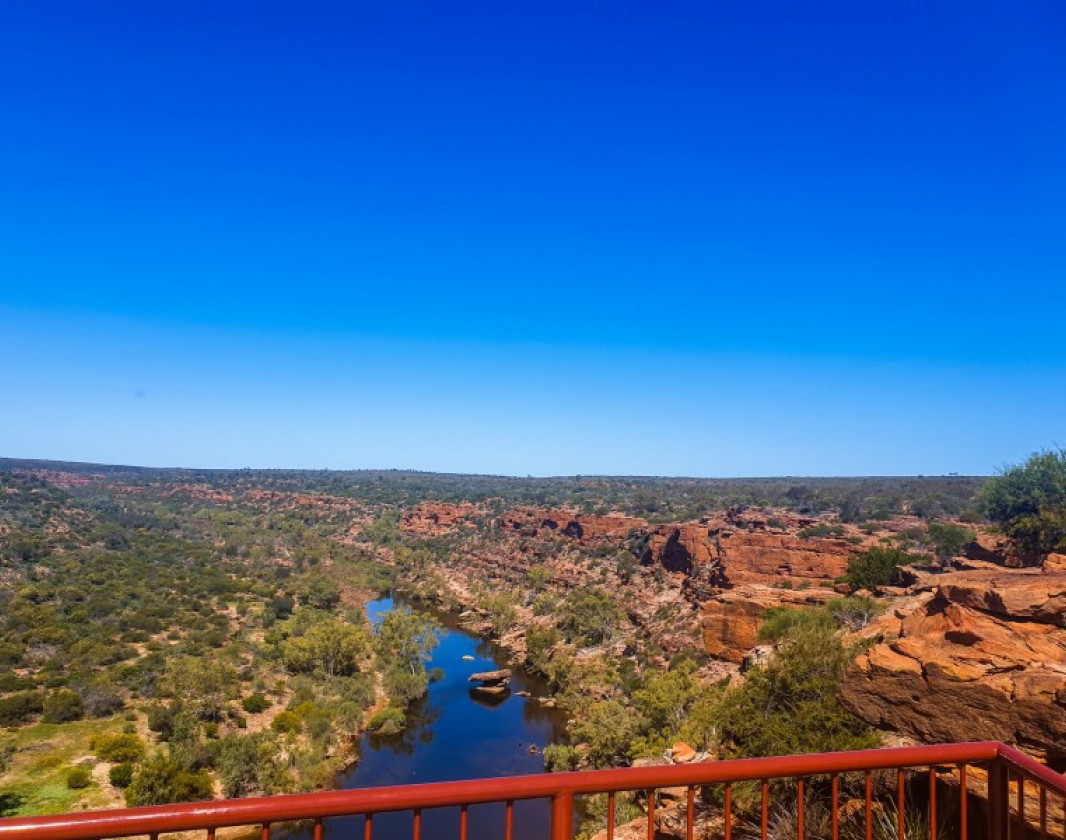
Located in Kalbarri National Park and aptly named after the shape of the rock structure seen from the lookout, the Hawks Head Walk is a 200m return walk from the main carpark and picnic area down a sealed path to the lookout above the mighty Murchison River.
Part of Kalbarri National Park network
Earn badges and points by completing this trail.
Trails WA supports the seven principles recommended by Leave No Trace Australia for minimising your impacts when using the trails.
Learn moreRead more about this trail
Kalbarri National Park covers a massive 180,000ha encompassing of sand plains, coastal cliffs and the spectacular deep gorges of the Murchison River.
Located within the Park, the Hawks Head Walk is a short 200m return walk from the main carpark and picnic area to a lookout providing extensive views of the mighty Murchison River. Hawks Head was aptly named after the shape of the rock structure seen from the lookout.Â
Interpretative panels provide visitors with some insight into how to read the rock patterns and structures of this ancient gorge, as well as explaining the diversity if life, the issues with feral animals and restoring the natural system within the gorge.
If you are lucky enough to visit during wildflower season (July to October) you will be met by a dazzling display of colour from the wildflower species of the region, many only found in the National Park, inluding Kalbarri Spider Orchid, and other common wildflower species, flame Grevillea, starflowers, smoke bush, orchids and many flowering wattles.
Â
(08) 9937 1104
Get your Visitor Guide & Map on the 'Maps and Brochures' Tab
Comprehensive information on the Coral Coast region including destinations, things to see and do, accommodation and tours.

Perched high above the winding Murchison River Gorge, Kalbarri National Park is home to some of Western Australia’s most iconic landscapes and resilient native species. Visitors can experience a striking mix of rugged geology, seasonal wildflowers and unique flora and rare native animals shaped by the harsh yet beautiful conditions of the Mid West.
The park boasts over 1,100 species of wildflowers, earning it a reputation as a botanical hotspot. The peak bloom occurs in early spring (August to October). Look for spreading coneflowers, pink pokers, and the vivid yellow and green Kalbarri catspaw. The area is also famous for unique orchids, such as the Kalbarri cowslip and greenhood, alongside bright yellow wattles blooming throughout winter.
The sandy plains and rocky gorge rims are home to the iconic Thorny Devil, western bearded dragons, and short-beaked echidnas. Wedge-tailed eagles frequently soar over the river gorges. In the surrounding heathland, you can spot emus, as well as Australian ringnecks, galahs, and brown falcons. Western grey kangaroos and wallaroos are common in the bushland, and the black-flanked rock-wallaby, which has a recovering population in the rocky outcrops.
Kalbarri National Park provides one of Australia's best opportunities to observe ancient sedimentary environments, early evidence of life on land and the powerful effects of erosion operating across vast timescales. From fossil-bearing sandstone and meandering river gorges to dramatic sea cliffs and natural rock sculptures, the park preserves a geological record that spans hundreds of millions of years.
The park’s spectacular cliffs, gorges and coastal formations are made of Tumblagooda Sandstone - a distinctive red and white banded sedimentary rock that was deposited during the Silurian Period, approximately 400-430 million years ago.
The Tumblagooda Sandstone is one of Australia's most significant geological formations because it preserves evidence of some of the earliest life to venture onto land. Fossil trackways and burrows found within the sandstone record the movements of ancient arthropods, including eurypterids (sea scorpions), trilobite-like animals and worm-like organisms that once inhabited this ancient coastline. These trace fossils provide valuable insights into ecosystems that existed long before dinosaurs appeared.
The park's most famous geological feature is the Murchison River Gorge, a spectacular canyon system extending for approximately 80 kilometres.
The formation of the gorge itself is relatively recent in geological terms. Geoscience studies indicate that tectonic movements elevated the landscape, which then allowed the river to erode deeply into the sandstone plateau, creating the steep-sided gorge seen today.
Trails such as The Loop, Nature's Window, Z Bend and Hawks Head provide outstanding views into the gorge and reveal the horizontal layers of Tumblagooda Sandstone.
The park's coastal section showcases a different chapter of Kalbarri's geological story. Along the Indian Ocean shoreline, cliffs rise more than 100 metres above the sea, where relentless wave action, wind erosion and weathering continually reshape the coastline.
Features such as Natural Bridge, Island Rock, Mushroom Rock, Rainbow Valley and Shellhouse demonstrate the power of this coastal erosion. Fractures within the rock are gradually enlarged by waves and weathering until arches, sea stacks and isolated rock remnants form.
Here is everything you need to know before visiting this trail.
0-30mins
.2km return
National Park Fees
Access to the following sites are 36km from town on the Kalbarri-Ajana Road. These are sealed roads suitable for any vehicles, with a loop-carpark, toilets & shelter.

Return via the same trail
Class 1
All abilities access, flat, even, hardened surface with no steps or steep sections. Suitable for unassisted wheelchair users and prams. Clear directional signage. No bushwalking experience required.
Group A - Urban Trails (Urban trails or short trails near facilities)
No drinking water is available in the park.
No towing (caravans, trailers, boats etc) are allowed within this area. (There is an unhitch bay just after the National Park Kiosk at the entrance of the park.)
December to April can be very hot, walk in the cooler parts of the day, carry adequate water supply
This is a day use park only and as such no camping is permitted.
25°C
Feels like 24°C
Max 26°C
Min 13°C
Earn points and badges and become a "TrailsWA Expert" by completing trails and leaving reviews.
Earn 1 point towards
your TrailsWA level
Earn the Wildflower Wanderer badge when you complete this trail.

We love to hear from people who've been on our Western Australian trails, so it would be most appreciated it if you wanted to leave a review.
Trails are free and offer countless benefits to our community, from fostering fun and fitness to encouraging social connection, exploration, and personal challenges. These exceptional trail experiences are made possible through the support and collaboration of these great organisations and initiatives:
Join trails wa to add this trail to your favourite. By joining you will also be able to rate and review trails and share your photos with other trail goers!
Sign in to your account to add this trail to your list of favourites, and much more.