Western Rosella
Platycercus (Violania) icterotis
Animalia: Aves
Your bookings
Koi Kyenunu-ruff, Goreng & Menang Noongar Country
This is the traditional Aboriginal name and country for the Stirling Range.
Part of Stirling Range National Park network
Earn badges and points by completing this trail.
Trails WA supports the seven principles recommended by Leave No Trace Australia for minimising your impacts when using the trails.
Learn moreRead more about this trail
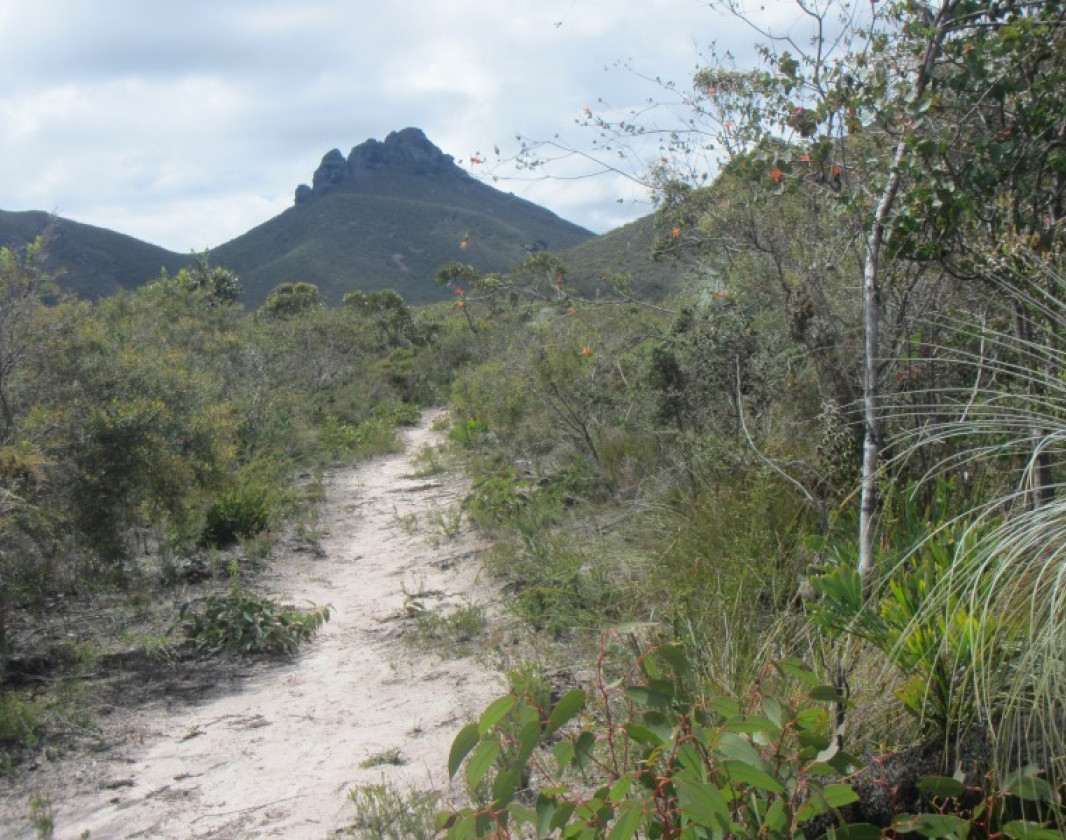
Talyuberlup is the most dramatic rock peak in the Stirling Ranges. Although only 783 metres high, it has a jagged, pinnacled castle-like summit.. The trail initially winds through an area of low woodland but then rises steeply up a gully. Then it heads for the base of the cliffs and then along the cliff line.
It enters a large cave that bores its way underneath the summit, from where you emerge onto the peak of Talyuberlup. The ascent is 600 metres over 1.3 kilometres. The path can be dangerous when wet.
(08) 6820 3700
Tourism WA website
Comprehensive information on the South West region including destinations, things to see and do, accommodation and tours.
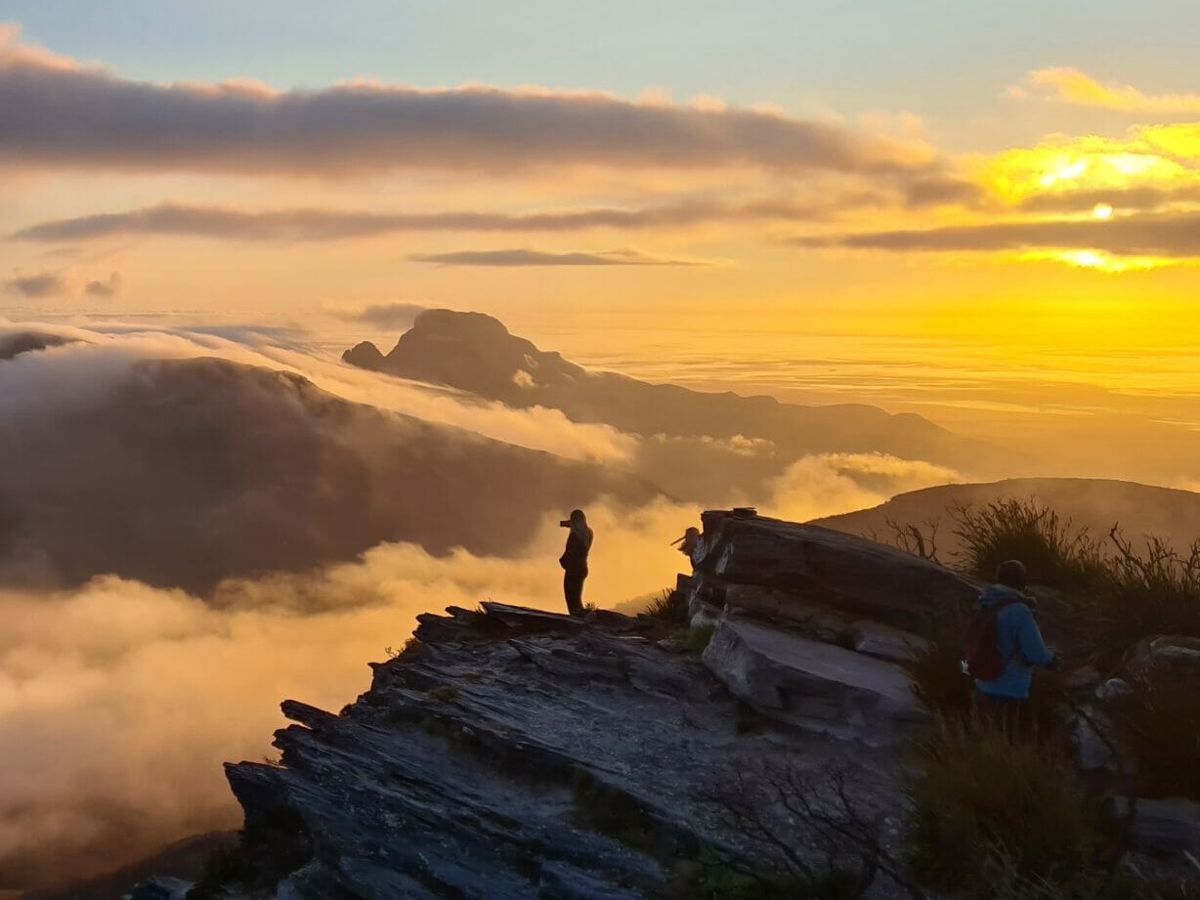
Stirling Range is also known by its Aboriginal name - Koi Kyenunu-ruff – meaning ‘misty mountains’, owing to the unusual cloud formations that often wreath the higher peaks.
Koi Kyenunu-ruff is part of the traditional country of the Menang and Goreng Noongar people, but the ranges have different meanings to each group.
The Menang and Goreng Noongar people have lived in and around the mountains for thousands of years. The surrounding plains and valleys provided important food resources, with women gathering roots, seeds and fruits while men hunted kangaroos, wallabies and other native animals.
Traditionally, Noongar families moved seasonally through the landscape, building small shelters and adapting to the cooler mountain climate by wearing kangaroo skin cloaks.
Following European settlement, much of the surrounding land was cleared for farming and grazing and families were displaced from much of their traditional land. Despite this, Noongar people have maintained strong cultural connections to the Stirling Range, which remains a place of ongoing cultural and spiritual significance today.
Aboriginal cultural content on this page has been developed with information sourced from Department of Biodiversity, Conservation and Attractions’ publications. It may not represent all knowledge or perspectives of Aboriginal people.
The Stirling Range National Park is known for its staggering range of wildflowers - more than 1,000 different species, some of which are found no where else.
Located in WA's Great Southern region, the Stirling Range National Park is an internationally recognized biodiversity hotspot. It is home to over 1,000 species of flowering plants - many found nowhere else on Earth. This diverse habitat provides vital refuge for a wide array of native mammals, invertebrates, and abundant birdlife.
The park is home to five major vegetation communities – thicket and mallee-heath on the higher ground, and woodlands, wetlands and salt lake communities on the lower slopes and plains. The higher elevations and cooler, misty conditions allow unique plants to thrive. The park is the exclusive home to several species of the iconic, brilliantly colored Mountain Bells (Darwinia). Over 128 orchid species bloom here, including vibrant varieties like the Cowslip, Purple Enamel, and hard to find Queen Sheba Orchid. Banksias, Dryandras, and Eucalypts, and feather flower species are prolific. Carnivorous plant varieties like the Albany Pitcher Plant (and localized sundews) can be found in moist, nutrient-poor, boggy areas. During spring the park is a breathtaking garden of wildflowers.
This diverse habitat creates a perfect shelter for many mammals, birds and reptiles, including the Western Grey Kangaroo, Western Pygmy Possum, Tammar Wallaby, and various dunnarts. The range hosts nearly 150 bird species, such as the endangered Carnaby’s Black Cockatoo, Emus, Wedge-tailed Eagles, Splendid Fairy-wrens, and Western Spinebills. Reptiles such as bobtails, monitor lizards, and venomous snakes (dugites and tiger snakes) are also native to the park.
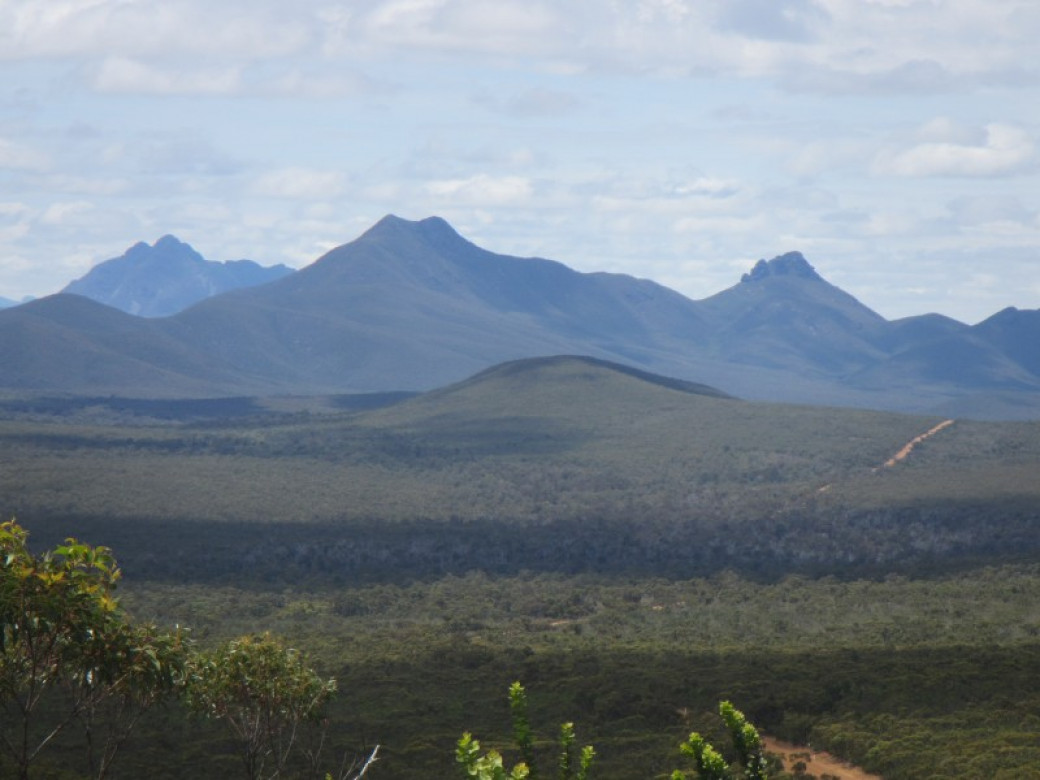
Rising dramatically above the plains of Western Australia’s Great Southern region, Koi Kyenunu-ruff (the Stirling Range) is one of the most distinctive mountain landscapes in Australia. For visitors today, the trails within the range offer more than spectacular views and challenging hikes. Every cliff face, rocky summit and folded ridgeline is part of a geological history stretching back hundreds of millions of years.
Koi Kyenunu-ruff owes its existence to immense tectonic forces that shaped the southern edge of Australia. When the supercontinent – Gondwana – broke apart into what is now Australia and Antarctica, a valley developed. As this low point developed, many layers of sedimentary rock were pushed ‘up’ to form a series of hills and mountains known as ‘rift shoulders’.
The range sits on the southern margin of the Yilgarn Craton — one of the oldest pieces of continental crust on Earth. South of the range lies the Albany–Fraser Orogen, a vast belt of deformed rocks formed between 1,200 and 1,400 million years ago.
Unlike the nearby Porongurup Range, which is made of granite, Koi Kyenunu-ruff is composed mainly of ancient sedimentary rocks including sandstone and shale. These sediments were originally laid down in the coastal shallows of an ancient sea, likely in a river delta environment. Over time, the sediments were buried, compressed and altered into the hard rocks seen today.
Evidence of this ancient environment can still be found throughout the range. Ripple marks and bedding layers preserved in the rocks reveal the movement of water and sediment long before the mountains existed.
The rocks of Koi Kyenunu-ruff have attracted scientific interest for many years. The Stirling Range Formation is now generally understood to be around 2.0 to 1.8 billion years old, preserving evidence of an ancient shoreline environment shaped by storms, longshore currents and tidal currents.
Fossil-like impressions found in the rocks have been compared with ancient jellyfish-like forms, but their age and interpretation have been the subject of scientific debate. These findings continue to reshape scientific understanding of the range’s deep geological history.
If we fast forward to around 55 million years ago, during the Eocene period, when sea levels were much higher than present levels, the peaks of Koi Kyenunu-ruff may have resembled a small archipelago. At that time, the shoreline extended close to the southern edge of the range.
The geology of Koi Kyenunu-ruff strongly influences its soils, vegetation and walking experience. Along many slopes, a layer of clay-rich soil slows the movement of water through the ground. These moist conditions can favour the spread of Phytophthora dieback disease, one of the park’s major environmental threats.
The most developed soils occur on valley floors where water collects and conditions are more fertile. This variation in soils and moisture creates a remarkable diversity of plant communities across the park, contributing to the Stirling Range’s reputation as one of Western Australia’s biodiversity hotspots.
Off The Beaten Track WA (OTBT) is Perth’s leading premier Hiking Experience & Adventure Tour operator, providing guests with over 70 safe, fun, inclusive experiences in a fully supported environment.
Here is everything you need to know before visiting this trail.
2-3 hours
2.6km return
Road 2WD
Stirling Range Drive, Stirling Range National Park, 430km south (5 hours) south of Perth

Class 5
Extreme trail with very rough surface, and may have very steep hills, arduous rock hopping or rock scrambling. Limited or no directional signage. For very experienced bushwalkers with navigation and emergency first aid skills, and high level of fitness.
Group B - Hiking & Long Distance Trails (Bushwalks and/or longer trails)
Walk safely. All walks in the Stirling Range are steep and have uneven surfaces. Wear boots or sturdy footwear, weatherproof clothing and sun protection. Take plenty of food and carry two to three litres of drinking water per person for half to full day walks.
Please take all your rubbish out with you.
Stay on the path. Be prepared for sudden cold changes that cause the temperature to drop and rain or hail to set in. Not suitable to walk in wet or windy conditions.
No pets , no fires
The Department of Biodiversity, Conservation and Attractions undertakes 1080 baiting at this location to reduce the impacts of feral cats and foxes on native wildlife.
Meat baits containing 1080 poison are laid in or around this area on an ongoing basis. 1080 is poisonous to humans and will kill domestic cats and dogs. Please leave your pets at home or prevent them from entering this area.
For further information contact your local Parks and Wildlife Service office or visit Western Shield.
15°C
Feels like 14°C
Max 15°C
Min 7°C
Earn points and badges and become a "TrailsWA Expert" by completing trails and leaving reviews.
Earn 3 points towards
your TrailsWA level
Earn the Tall Peak badge when you complete this trail.

We love to hear from people who've been on our Western Australian trails, so it would be most appreciated it if you wanted to leave a review.
Trails are free and offer countless benefits to our community, from fostering fun and fitness to encouraging social connection, exploration, and personal challenges. These exceptional trail experiences are made possible through the support and collaboration of these great organisations and initiatives:
Join trails wa to add this trail to your favourite. By joining you will also be able to rate and review trails and share your photos with other trail goers!
Sign in to your account to add this trail to your list of favourites, and much more.