






Weebill
Smicrornis brevirostris
Animalia: Aves
Your bookings
Banyjima & Innowonga & Kurrama Country
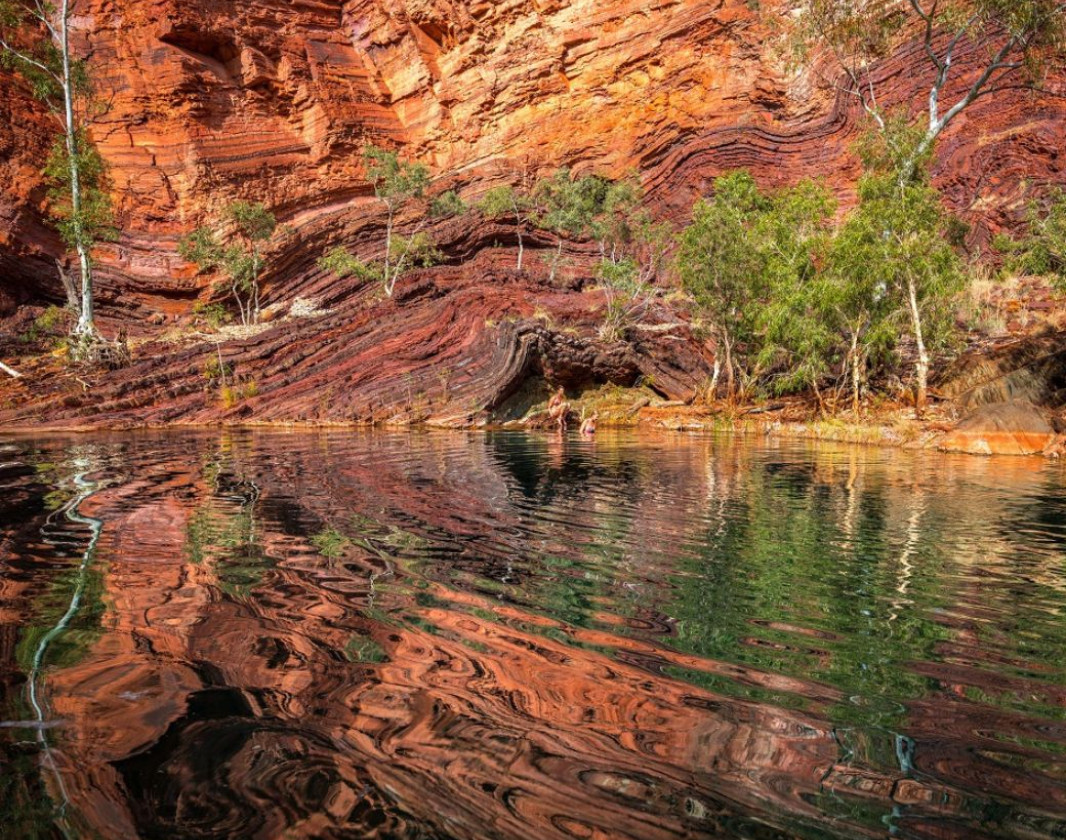
This is a dramatic gorge, full of colour texture and reflections and a great spot for a swim.
Hamersley Gorge is in the north-west of Karijini, further afield than the other gorges. Swirls of rock sweep down through the gorge and waterfalls rush into tranquil pools. There have been improvements to the site including sealed road access to the lower car park, a new constructed lookout, toilet and various infrastructure items.
Part of Karijini National Park network
Earn badges and points by completing this trail.
Trails WA supports the seven principles recommended by Leave No Trace Australia for minimising your impacts when using the trails.
Learn moreRead more about this trail
There are a couple of walks around Hamersley Gorge.
Hamersley Gorge Walk (Class 4) is a 1 kilometre, 1 hour return walk. One of the more difficult walks in the Gorge. Swirls of rock sweep down through the gorge and waterfalls rush into tranquil pools.
Hamersley Waterfall Walk (Class 4) is a 400 metre, 30 minute return trip. This walk boasts ever changing light and astonishing colours and reflections which highlight the complex geological forces in the landscape. This walk begins as steps, follow the steep decent down to the pool at the base of the waterfall. There are some obstacles, a good level of fitness is recommended. Do not attempt to access upper pools.
Karijini is a bushwalker's delight, so while in the area try the many other walks including Knox Gorge Lookout, Knox Gorge, Joffre Lookout, Joffre Falls and Handrail Pool.
Handy Visitor Guide on the Maps and Brochures Tab
Parks and Wildlife Service webpage for Hamersley Gorge
Tourism WA webpage for Hamersley Gorge
Comprehensive information on the North West region including destinations, things to see and do, accommodation and tours.
Comprehensive information on the Coral Coast region including destinations, things to see and do, accommodation and tours.

Karijini National Park features over 500 native flora species, transitioning from spinifex grasslands on the plains to lush ferns, paperbarks, and ghost gums in the deep gorges. The area is home to diverse fauna, including red kangaroos, euros, Rothschild's rock-wallabies, echidnas, over 100 bird species, and numerous reptiles.
The vegetation of the park is heavily adapted to the arid climate, where the dry plateaus and hill slopes are dominated by spinifex grasses, mulga (Acacia aneura) stands, and snapping gums. The deep, shaded gorges support radically different, moisture-loving plants, with dense, tropical vegetation such as ferns and towering paperbark trees. Following rains, the landscape blooms with purple mulla-mullas, Karijini wattle, yellow flowering cassias, and northern bluebells.
The rugged landscape of the Pilbara provides a critical habitat for a variety of mammals, birds, and reptiles. You will frequently spot red kangaroos and euros out in the open, while Rothschild's rock-wallabies inhabit the rocky gorges. The park also hosts shyer, nocturnal species like the Pilbara ningaui, northern quolls, and echidnas, plus the rare Western pebble-mound mouse that constructs intricate rock piles on stony slopes, unique to the Pilbara region. Over 100 species of birds thrive here. Iconic sightings include the tall, crested spinifex pigeon, wedge-tailed eagles soaring high above the chasms, and vibrant rainbow bee-eaters. A wide variety of lizards and snakes live in the park, including the large sand goanna (bungarra) which can grow up to 1.6 meters, various dragons, and pythons.
A striking highlight of the park are the termite mounds, large dirt structures that are scattered throughout the spinifex grasslands.
Karijini National Park is internationally recognised for its geological significance. Its rocks preserve evidence of ancient oceans, the emergence of oxygen-rich environments and some of the earliest chapters of Earth's history.
The park's banded iron formations, dramatic gorge systems and exceptional exposures of ancient rock provide scientists with invaluable insights into geological processes that occurred billions of years ago. For visitors, Karijini offers a rare opportunity to walk through landscapes that reveal the deep history of our planet in extraordinary detail.
The rocks exposed throughout Karijini formed between approximately 2.5 and 2.0 billion years ago during the Precambrian Era. At that time, the region lay beneath ancient oceans where layers of iron-rich sediments and silica accumulated on the seafloor.
These sediments eventually formed the banded iron formations that dominate the Hamersley Range. Alternating layers of iron minerals and silica created distinctive red, silver and black bands that remain visible in many of Karijini's gorge walls today.
As visually spectacular as they are, these banded iron formations also tell the story of one of the most important events in Earth's history—the rise of oxygen in the atmosphere.
More than two billion years ago, microscopic photosynthetic organisms began releasing oxygen into the oceans. This oxygen reacted with dissolved iron in seawater, causing iron minerals to precipitate and settle onto the seafloor. Repeated cycles of deposition produced the characteristic bands visible within the rocks today, providing evidence of the Great Oxidation Event - a period when oxygen levels increased dramatically and permanently changed Earth's atmosphere, paving the way for the evolution of complex life.
Karijini National Park therefore preserves not only an important geological record but also a record of a transformative chapter in the history of life on Earth.
While the rocks themselves are billions of years old, Karijini's famous gorges are geologically much younger.
Over millions of years, uplift of the Hamersley Plateau increased river gradients and enabled streams to cut deeply into the resistant iron-rich rocks. Seasonal rainfall and flowing water gradually carved the narrow, steep-sided gorges that characterise the park today.
Gorges such as Dales Gorge, Hancock Gorge, Weano Gorge, Knox Gorge and Joffre Gorge reveal spectacular cross-sections through ancient rock layers. In some places, gorge walls rise more than 100 metres above the valley floor, exposing rock formations that would otherwise remain hidden beneath the surface.
The narrow slot canyons found in several gorges formed where water exploited fractures and weaknesses within the rock, progressively deepening and widening these natural pathways.
Karijini's waterfalls and permanent pools add another layer to the park's geological story.
Water flowing through fractures in the rock dissolves minerals before emerging as springs or flowing into gorge systems. Over time, minerals carried in the water can precipitate to form deposits known as travertine, creating terraces and natural dams around some pools and waterfalls.
Features such as Fortescue Falls and Fern Pool demonstrate the interaction between geology, groundwater and surface water. These permanent water sources support unique ecosystems that contrast sharply with the surrounding arid landscape.
Here is everything you need to know before visiting this trail.
1hr return
1km return
Entry fees apply to Karijini National Park
Air and road to Tom Price. Road to trail - 4WD recommended.
Just off Nanutarra Wittenoom Rd, Karijini National Park. 130km from Tom Price, which is 1500km (16 hours) north of Perth
Class 4
Difficult trail with rough surface that may have very steep hills or extensive rock hopping. Directional signage may be limited. Bushwalking experience, navigation and emergency first aid skills, and good fitness required.
Group B - Hiking & Long Distance Trails (Bushwalks and/or longer trails)
Carry adequate water. To avoid dehydration each person needs to drink one litre of water every hour of walking
Wear sturday footwear and remain on established trails.
Avoid sunstroke and sunburn - wear sunscreen, long sleeves and a hat.
During summer, temperatures frequently top 50 degrees Celcius. Carry plenty of water at all times. Flash floods can occur – do not enter gorges if there is rain in the area. If it starts raining when you are in a gorge, leave immediately.
Leave gorge promptly if it begins to rain.
Do not dive or jump into water.
Avoid walking on wet rock.
20°C
Feels like 20°C
Max 32°C
Min 18°C
Earn points and badges and become a "TrailsWA Expert" by completing trails and leaving reviews.
Earn 3 points towards
your TrailsWA level
Earn the Waterfalls , and Gorges badges when you complete this trail.
We love to hear from people who've been on our Western Australian trails, so it would be most appreciated it if you wanted to leave a review.
Trails are free and offer countless benefits to our community, from fostering fun and fitness to encouraging social connection, exploration, and personal challenges. These exceptional trail experiences are made possible through the support and collaboration of these great organisations and initiatives:
Join trails wa to add this trail to your favourite. By joining you will also be able to rate and review trails and share your photos with other trail goers!
Sign in to your account to add this trail to your list of favourites, and much more.